The Sanguinarian

The Sanguinarian

Sunday, 8 October 2017

Review- The Three Psychos- Yash Pawaskar


The Three Psychos is a suspense thriller, where three stories are inter-related. Three stories of suspense and intrigue. So first, let me list the good points.

Unlike most debut authors who go for romance, Yash went for a thriller.

Unlike most new authors flooding the market, Yash writes really well- his prose is crisp, grammar is good, style flows.

I like how he experimented with first person narration, in the form of a tryptich.

The plot is original, and very interesting. It develops in a way that keeps the readers hooked. I did not feel  like putting it down for a second.

The characterization is amazing. I could empathize with Alex, Amol and the 16 year old boy- all of them were imperfect, but relatable and real.

The pacing is good, and the way each chapter ends on a cliffhanger is a fantastic idea.

The climax is also very satisfying.

I only wished the book was better edited. There were small grammatical errors throughout- not a big deal, but since the writing is so good, I expected the manuscript to be more polished.


But all in all, I really loved the book. I wish to read more by the author in the future!

Buy the book here: The Three Psychos

Wednesday, 1 February 2017

Review-Figmented Reality- Zuko


Addiction blurs our hold on reality; people say. But what if addiction becomes our reality? Siddharth had a fair few addictions in his wake. The challenge now was to differentiate between the ideal world and the real world. Will Siddharth be able to overcome his addictions and find true love. Or is it just another addiction? This book is not a biography of the author but is written in a way that author is the protaganist. 


Figmented Reality starts out as the story of one Siddharth, which he narrates himself. From page 1, the author weaves an interesting tale with Siddharth's internal monologue. The reader gets to experience a colorful miasma of thoughts...from his addictions to his rift with his conservative parents. From his misogyny to his awkwardness with women. From his obsession with sex, porn and compulsion to talk to women about porn, to his erotic fantasies about a woman who's more than a decade older than him.
His failed love stories and friendships. His horrible history which was responsible for his addiction to sex.

What I liked about the book is that it's very realistic. Unlike the way-too-saccharine and impractical books about human nature and relationships selling like hot cakes in the mass market, this book keeps it real about how males think; about addicts, about chauvinists and their attitudes towards women; about grown women who are sturggling between love, freedom and the 'responsibility' towards children and family society imposes on them.

Yes I did find some crass generalizations which annoyed me, but otherwise, I liked the story, especially the twist at the end- the direction his thoughts take.

However, there are problems with the execution of such a brilliant story.

First is the grammar and language. The way this book is written, it's not even first draft material. The author needs to work on his prose style, the language, the phraseology, grammar and punctuation. The finesse is missing.

Second casualty is the editing. I don't know why no one bothered editing this book properly to iron out the errors, the typos and the technicalities. Probably a good editor would have suggested erasing the generalizations the author seems to have carelessly made in the book.

Every great idea fails to work if executed poorly. Therefore, I'd suggest the author work hard on his prose skills, language, punctuation and storytelling. The author has potential much greater than exhibited in this book.

Wednesday, 4 January 2017

Review- Confused Bastards


Blurb: What happens when three entrepreneurs initiate a start-up which shocks the nation? 
Aakash, Jai and Vivek are mostly usual in their ways, except for some. Struggling with their own inner conflicts as well as the cruel world outside, they decide to show the world their true potential. To make it big. But how? They become the voice of the nation by starting up an online platform where people can upload unabashed, unapologetic videos, venting out their angst against people, politics, bosses, lovers, taboos, or just about anything. Even the founders themselves. 
The platform spreads like wild fire. But when has fire doused without burning a few! 
Confused Bastards is not just a witty, gritty, fast-paced journey of three friends, it’s also an intolerant story for a tolerant country! 


Silently take a bow out the door, Chetan Baba. Because here is the proof that new writing coming from young authors in India is not your hackneyed IIT jao- ladki patao-sex karo-BC karo plot. 

Confused Bastards is refreshingly funny, non-preachy and very, very real. 

Throughout the story of Aakash, Jai and Vivek, their trials and tribulations, failures and successes, flaws and qualities, I was constantly giggling and laughing. 

When you stop looking at the IITians and IIMians, it's guys like these three which form the real youth of the country. The varying, undulating tapestry of the latent and overt aspirations and opinions of India's youth is made of the thoughts and aspirations nursed by Aakash, Jai and Vivek. 

Aakash, who has many good ideas, each a subsequent failure. And he has a rich father who constantly berates him. He's also a raving misogynist who believes in bang-bang-boom without batting an eyelid or worrying about committed attachments; even describing every sexual conquest in terms of the Kamasutra.

Jai has a boss who's a monster, sets impossible goals for his employees and works them like cattle on a farm. Jai wants to quit his job, but lacks the confidence to take such a risk, owing to pressure from his parents and their sacrifices for their áverage' son. I loved his track with Sneha, the woman he later falls in love with. 

Vivek has a failed marriage and is filled with control issues. Being a topper since childhood, he cannot tolerate failing at something. And has an equally funny but irritating habit of worshiping all Gods. 

They launch this website, as a start-up, where people with any sort of grudge can vent their spleen. The story is dedicated to a detailed portrayal of how the boys go about getting angel investors and then setting up the company. And then the stories and people they encounter in course of getting good videos. 

The way the corporate world ditches you at the slightest hint of trouble has also been portrayed very well. It's about how the boys make some wrong decisions, even spend a few nights in jail, and lose everything all over again. Then they fight their personal demons, overcome their problems with their own families and thought processes and find their way in life again.
The conflict and characterization has been played out well. I liked all the lead characters and the supporting ones too.

The editing is excellent, and the prose quality is high. The author has command on the language and grammar, and the storytelling as well. The plot is original and the style is ingenious. 

I cannot find anything to criticize in the book, except perhaps Aakash gets a little too obnoxious in his misogyny at times. 

Read Confused Bastards for a refreshingly honest and fun take on the new aspirations of the millenial youth in India: Confused Bastards

Review- Pishacha- Neil D'Silva

Pishacha: A tale of love beyond births by [D'Silva, Neil]

On the outside, he is a Pishacha – a terrifying demon compelled to eat human flesh to survive. Yet, inside, he has a tender heart that still pines for the lover of his previous human birth.

More than a century later, when he discovers that his lover has been reborn in a rich Mumbai household, and is now a beautiful woman, his heart begins to beat again with a happy rhythm.

There are monumental obstacles in his path though, the least of which is the fact that she loves another man. But, the biggest challenge is that she is human and he is demon.

To make her his, he will have to become human again; and to accomplish that, he will have to fight holy men and witch-mothers and giants, and challenge the gods themselves.

From the best-selling author of Maya’s New Husband, comes a tragic tale of forbidden love — Pishacha. 


Horror thrillers written in India rarely push the boundaries of storytelling, ideas of what constitutes horror, and language and prose style. 

Pishacha by Neil D'Silva is one of the happy exceptions. 

This is a compelling, hypnotizing novel that I finished in a single sitting! I was up the entire night, reading this. And I was spooked enough to look at the ceiling every few minutes for a black, amorphous shape sneaking towards me... 

Pishacha mashes genres very well- supernatural horror, suspense, erotica, and even a little bit of historical fiction is woven into the story very well. 

Neetika is a college student being chased by this presence she feels is continuously watching her, spying on her and chasing her everywhere she goes. She's in a relationship with Yug, a dashing, dapper guy who seems to be the perfect boyfriend- handsome, caring, intelligent and successful, and one whom her father too approves of. He even proposes marriage and she is about to agree...when a weird series of events rudely interrupt their union. 

Followed by weirder incidents in Goa, where Neetika takes a trip with her friends post exams. And then uncovering the secrets behind the life and death of her mother, who left her at childbirth. Plus the sudden appearance of a young man who buys a house from Neetika's Dad and sleeps with a strange woman called Malini. 

And then there is Pishacha himself. The story of his entry in the realm of Earth and the world of humans is as exciting as the journey he undertakes across India to obtain his love. 

This is where Pishacha scores- giving the bad guy a background, and the strong, redeeming emotion of love in his heart. The reason for which he comes back from some far off corner of the universe to find his love, Neetika. He wants to become a human to obtain her, and for that he will fight anyone- witches, holy sages etc. 

When Neetika goes off to investigate the mystery of her mother's death and the mystery behind her own visions, followed by Yug, and comes face to face with the Pishacha,does the mystery unfold in a shocking, nail biting climax. 

The gore scenes are done well. The sex is only as much as needed. The suspense behind the intertwined histories of all lead characters has been done nicely. 

Conflict is fleshed out well, and characterization is good. 

The plot is original and the pace is heady, keeping the reader hooked at every chapter ending and every twist in the tale. The quality of prose is high, grammar and punctuation is perfect and the style is very ingenious. 

Only nitpick I could find is that the language, in places, is a bit dated. But it doesn't take away from the story in anyway. 


Pishacha is a step up on Neil's bestselling debut Maya's New Husband. 

I'd say pick this one up for an exciting, nail biting experience if you dig supernatural horror, original storytelling, Stephen King and well written books. 

Pishacha

Tuesday, 3 January 2017

The Murder of Agnel Wilson- Award Winning Short Story

The murder of Agnel Wilson has been one of the most talked about events in the Christian Colony, Orlem, Malad East, Mumbai, for several years after it happened. Bungalow No. 237 still continues to be a source of intrigue, and a hot topic for gossip and speculation, amongst the residents of this Colony.
237, which lies empty and abandoned today, used to be the residence of the Wilson family -- young, handsome Agnel Wilson, his seemingly demure but ostensibly beautiful wife Rebecca, and their infant girl, Mary Wilson.
“But since Agnel died and Rebecca was taken away by them, no family has come to live here. This house has been on the market for five years, but no one has bought it yet. People are scared because of the rumors surrounding the house…” Mrs. Gonzalez, from Bungalow 239 suddenly lowers her eyes, and stops talking, hesitation  at saying anything further writ large on her face. 

Read on... 

Tuesday, 6 December 2016

Review- Double or Quits-Shilpa Gupta


Blurb: Racy, realistic and fast paced, Double or Quits traces Jyotsna Singh’s story against the backdrop of the treacherous stock markets. Losing her father at the age of 12 and brought up under frugal circumstances, Jyotsna grows up too soon. Nervy and edgy by nature, she morphs into a confident and charming young woman with a successful career in Investment Banking. Enter Aryan Sahani, rising corporate star and billionaire who wraps Jyotsna in his charms, but has plans of his own. Driven by her loyalty to the firm, a desire to break out of her lower middle class moorings and misplaced love, Jyotsna overreaches. She is soon faced with the dark side of the stock markets – a world where ambition, greed and fear rule and reputations are lost a lot faster than they are built. Will Jyotsna be able to resurrect her life? Will she find the true love she has been craving? Double or Quits is a tale of love, betrayal and courage. It is a tale about falling down, but not staying down. 


There are some books which WOW you from the moment you read the first few pages to when you have read the last page and closed the book. There are some books you enjoy reading, and then forget about within days. There are some books that disappoint you within the first few pages and you're like, I'm closing it and relegating it to the trash right now. 

Double or Quits falls on the better side of the spectrum. 

I wanted to read this book. Despite a lot of things which went wrong in the execution, I wanted to read the book and was eager to finish it. And I did. 
This is one of those books which gets some things right and some wrong. 

To begin with, Double or Quits is a story with great potential but faulty execution. 

The things this novel, set in the cut-throat corporate world, gets right: 
1. I liked Jyotsna a lot. She's my kinda gal- smart, strong, independent, tough and a go-getter. She's secure enough in her own worth as a person and doesn't need a man to validate her; but at the same time she knows how to appreciate genuine admiration when it comes her way. I also liked that she's liberated and puts her career first; and isn't a pushover whom society and family can manipulate into submission. 
2. I liked Jyo's broadminded mother and Grandma. Amazing women- what wouldn't one give to have such supportive, understanding and liberal parent and grandparent! 
3. I like the profusion of good food in this book. 
4. I loved Nitin's character too. He's my kinda male feminist. The way he stands with Jyo through the most difficult phases of her life is amazing. And of course, he's well rounded as a person- smart, driven, intelligent, successful and good looking.
5. I liked how Jyo, despite being in a situation where she had to bear punishment for mistakes she didn't make, makes the most of it, works her way through and comes through with flying colors. This is good characterization- putting your character through the meat grinder, testing their resilience and then making them rise from the ashes like a phoenix. 
6. The corporate world has been explained very well. I'm a scientist by profession, and have little or no idea of corporate world or terms, but Shilpa, having more than a decade's experience in Investment Banking herself, breaks down the world of major corporations for us, nicely depicting the high stakes, the politics and backstabbing and the adrenaline rush. It made it easier to understand the story. 
7. The plot is original and the story line is new and refreshing. No romantic nonsense. The suspense has been maintained well throughout. 
8. Aryan's character, as well as those of the other supporting characters, have been etched well.
9. I liked Sanchita and Richa's characters- supportive girlfriends women like Jyo need for much needed encouragement and support- and the equation of trust, love and bonhomie the three women share.

Now let me come to what this novel gets wrong: 

1. More telling and very less showing. This makes it difficult to visualize the scenes properly, or immerse myself completely in the story. There is narration instead of proper scenes. I mean I know that  the protagonists are having dinner or making love or engaged in a high-power corporate meeting, but there is no context, no emotional intelligence in the scene. The author, instead of zooming in on the scenes to help us connect with the story, has rather skimmed through, jumping from one scene to another within the same chapter and giving us only a glimpse. I wanted a lot of scenes.
2. The language fails to move me. Some stray lines and phrases stand out in brilliance, but otherwise the prose is clunky and refuses to flow. It's not that the language is pedestrian, or I was expecting a very high level of English. But it could still have been better- more taut and crisp. There are no grammatical mistakes as such, but still, something was missing here. 
3. The start could have been better. When I start reading something I want to see something major happening, something which already makes me apprehensive about what will happen next. That was missing here. For example, the build up could have been in a way that the protagonist has a presentation whose outcome is important for her, and she's apprehensive about how it will go. 
4. Jyotsna's character does things very anachronistic to her personality, at times. Why does she go out on a  date with Aryan the same evening he humiliates her in front of her colleagues? Why does she trust him so blindly with regard to business when she only has an affair with him? And Aryan keeps repeatedly insulting her and she still keeps going out with him. He continues to be evasive and secretive and she blindly continues to trust him. She goes on a vacation to Malaysia with him when they've barely started dating, and even sleeps with him without first knowing him well. All these are at sharp odds with her high self-esteem, cautious nature and low threshold for sexist crap. Why would she tolerate a sexist who constantly subjects her to gaslighting? I mean we all do stuff which is out of character, but this is just not done. 
5. Does anyone say 'Gosh' much these days? 
6. At places the author goes too overboard with corporate jargon. Now I understand that being a corporate woman herself, she has the instinct to talk in terms of Investment Banking and such. But that is where authors who create stories set in the world they themselves inhabit should be careful- to use enough technical terms to paint a credible picture of the character's profession, but not go overboard so non-corporate people find it boring. 


All in all, I praise Double and Quits for its maturity, originality of content, and that it doesn't waste time with over-the-top romantic drama. This book has a lot of important things to say, and at places it does that very well. At other places, though, it could have been written better. The author can do so much better- she shows promise and potential.

But I would still like to applaud this novel for making a difference, and for encapsulating the messages of women's emancipation that it does. 

And I wish Shilpa all the best for her next book.
Double or Quits

Give this book a try, I'd say. You can buy a copy here: 


Thursday, 1 December 2016

Review- Birds of Prey- Archana Sarat


Blurb: You wake up, parched and famished, at the bottom of a deep well—dark and dingy with the foul smell of excreta and rotting scars and no seeming way to escape—what do you do?
This is the predicament that ex-ACP Anton Pinto faces when he reluctantly joins the investigation into the mysterious disappearances of men from affluent families of Mumbai. There is an inexplicable pattern behind the abductions and all suspicions point towards an old, physically-challenged, mysterious lady. Soon, Anton discovers that the seemingly unrelated men have one common link—the most popular and expensive international school in Mumbai.
Following clues that span from schools and old-age homes to illegal dingy hospitals, Anton is led through a labyrinth of incest, abuse, torture and suffering, spanning decades. 
What secret does the school hide behind its gates? What was the undisclosed crime that is thirsty for justice? Will Anton be able to save the men? Will justice be served? 


First of all, let me congratulate Archana on getting her book out. I know Archana for nearly four years now and I can personally vouch for her competence and sophistication as a writer. I had the privilege of getting a signed copy from her in return for an honest review. 

Birds of Prey identifies as a crime thriller, and it lives up to its stated genre by employing all the tropes necessary for a police procedural- there's an ex-ACP, a serial killer, a criminal profiler, other cops, an officious and incompetent police force, an apathetic boss and colleagues etc. 

I finished this book in 2 sittings. First of all the book manages to hold the reader's attention and maintain the suspense, second of all it's written in simple language ( not pedestrian. Simple. There's a difference between the two!) 

Let me enumerate the points on which the book scores first: 

1. The suspense has been created and maintained very well. Readers like me, who are a sucker for crime novels, appreciate the feeling of nail-biting tension and apprehension...that feeling of what will happen next? 
2. The author portrays both the city Mumbai, where the book is set, and the life of a Tamil family in Mumbai, very well. 
3. The characters are well fleshed out- especially Anton and his wife Sheeba. The number of characters is less in the book so it's easy to keep up with who is whom. Every supporting character- from the stubborn boss to the quack who performs illegal abortions and his assistant, has been etched well.
4. The language is simple without being pedestrian. Anyone with a basic knowledge of English can understand this well. The author doesn't waver from the tenor of her language quality throughout, and that is appreciable. The prose is eloquent without being grandiose, and suits the potboiler character of the story well. So full marks to the author for that. 
5. The author has written the novel from both the protagonist and antagonist's POV. Again, this is appreciable. Crime novels usually stick to the trope of the villain being an out-and-out bad guy who doesn't deserve a back story or an empathetic hearing. But here, the antagonist has been portrayed amazingly well, without being glamorized. One wants the hero to win while also feeling for the bad guy who might not be so bad after all, just misguided and lonely; but their actions deserve no justification. 
6. The conflict has been created well. Anton and Sheeba's marital troubles, his going to help his ex-employer, the Mumbai police, despite their apathy towards him when he needed their support the most; his dilemma of going back to the job he loves or staying back with his family in Goa; Sheeba's (justified) objection to his returning to work for the police...this is all very relatable stuff. This happens with us lay folks all the time. And again, we feel for the characters. 
7. The plot is original and intriguing, and the story is something unique. 
8. The prologue in itself is gripping and taut. Again a good point for which author gets full marks. 
9. The issue of child abuse has been tackled well in this book.

Now for the points I feel should have been addressed in the book: 

1. Grammatical mistakes: At times they take away from the otherwise well-written prose. And also mar the high quality of language and prose. This is not the author's, but the editor's fault. Why didn't they iron out the inconsistencies? The author has worked hard on her craft and it shows. It's the editor's job to iron out the inconsistencies and make the writing error free. Small typos are no problem, but in a book of this caliber it is an issue.
2. The portrayal of the criminal profiler: Now I'm not saying that crime authors have to be experts in criminology. But the profiler could have used much more professional language and terminology. That matters in a crime novel, specially if it's written with a psychological POV. Even when the cops discuss about the murders being serial crimes, their analysis falls short of professional. Yes, in India, the concept of criminology or behavioral psychology hasn't taken root yet. Not among cops, especially. But here is where the author could have made a difference by doing some in-depth research on criminology and making the cops and profilers talk like professional experts. 
3. At places, there are odd turns of phrases. This is again the editor''s prerogative to notice and correct. At one place there is confusion between the names of victims. Again the editor's fault. 

All in all, Birds of Prey is a well-written, nicely plotted crime thriller. It will make you think about child abuse in India, about the effect it has on human beings, about how societal apathy adds to the entire vicious cycle. 
Go read this book if you need a breather from the Bhagats, Duttas and Singhs of literature in India. 

Birds of Prey


Friday, 4 November 2016

NaNo'16: Character Speak: Tony from The Devil's Whisper on A Bad Break-Up


Women. Are. Exhausting.

Call me an obnoxious sexist if you will. Accuse me of being a moron who generalizes about women, paints them all with the same damn brush. Because #NotAllWomen right?

But. Women are exhausting. And no one exemplifies exhausting women more than my ex, Sarah De Marco.

Before I start elaborating on the break-up itself, let me elaborate. I am a cop who, most days of the week, ends up working a 16 or 17 hour shift. By the time I come home I am so tired I can feel my bones rubbing together. I'm sapped of all energy after working a job that's as difficult as it's thankless.

The Relationship 

Sarah and I were in a relationship for six long years. She was a local marketing executive for a pharmaceutical MNC's Mumbai chapter. Which meant that she also worked for nearly 14 hours a day, and came home as tired as I was. It was almost like we came home only to sleep, falling asleep in each other's arms. We were as sapped of libido as of energy so we never did get in the mood for romance most days.

Sundays were mostly meant to sleep in but we used this one day we had to ourselves to sleep in and catch up on some long-pending lovemaking. Otherwise, sex was only accidental, like if we ran into each other in the shower or, while we cooked together, I opened the fridge and found two bottles of chocolate sauce instead of one. Or when I came home with a backache and she gave me a back rub to ease the tension ( which led to a different sort of tension).

I thought we were doing okay. The sex was good, we had our own circle of friends we often hung out with, we liked a lot of the same things: Books, movies in languages we couldn't decipher, coffee, chocolate brownie with ice-cream.

The Break-Up

Until one day, I found her cheating on me with a colleague of hers, Parvez. In my apartment which we shared. The colleague was also in a live-in relationship with another woman in his department. We'd gone out on double dates many times- movies, dinner, the occasional bar or discotheque.

I asked them both to get dressed and get out of the house. I was too conked out that night to launch into a full blown tirade. After they left I collapsed on the bed and fell asleep, crying.

She called me the next day on my phone- 48 times in all. I didn't pick up her calls and went to work, as usual. She called my partner and best friend Rohit- and he first convinced her he would speak to me. When he did, I asked him not to entertain her calls anymore. Then she called Nina, Rohit's fiancee, who was also Sarah's BFF, to convince me to pick up the phone. I refused. And all this happened in one day, let me tell you.

When I came home that night, I found her waiting in the living room, dressed in the same clothes as she had gone out in the previous night. I didn't say anything at all to her. I didn't know what to say. When something's wrong in a relationship you talk to your partner don't you? You talk to them about what you feel is wrong, rather than blaming them for the wrong by cheating on them. For the life of me I couldn't figure out why she cheated on me. I was numbed and it was like my mind automatically turned itself off as soon as I entered my house.

I took off my shoes in the living room, and went straight to the kitchen. Poured myself some wine, came back to the living room, sat at the dining table and quietly drank. She was still sitting on the couch. A pall of deathly silence hung around the house, as if someone had died and left a gaping hole in the universe. Well, something died, right? Something died, inside me. I can't tolerate people who cheat- in exams, in relationships or in anything.

Then she started to mumble something about 'working late', 'no love life', 'not socializing enough', 'too busy to care', 'cold and unresponsive', and a lot more I couldn't hear because the sound of gushing blood in my ears was drowning out all other sounds.

"I'm sorry, are you talking to me?" I finally asked.

"What? Of course I'm talking to you!" she replied.

"Are you done?"

"No. I want you to understand why."

"And what if I don't?"

"But you have to."

"Get out of my house."

"Excuse me?"

"You heard it. Get the hell out of my house. I'll have your stuff packed and sent wherever you want- you don't even have to come to collect it. Now get the hell out, before I lose it."

"But I..."

"Out. I don't want to hurt you, and I won't ask again. Get the hell out. I don't want to see you or hear from you again."

"Where will I go this time of the night?"

"How do I know? Go wherever you please...you're free of me now. Off the top of my head, I'd suggest your new boyfriend's house. You can celebrate your break-up there, have fun."

She got up from the couch, and picked up her purse. She also started crying at the same time. Why do women start crying when called out on their mistakes?

She stormed out, banging the door shut in her wake. I cried myself to sleep again.

The madness that came after 


For the next few days she would text me, instead of calling. She knew I wouldn't receive her calls. Nina kept trying to persuade me to let her explain. I kept refusing. Sarah kept on texting she was sorry.

Sorry? For what? For cheating on your partner of six years for no apparent reason? If she had told me what left her dissatisfied in the relationship, I would've tried to rectify it. I would have done it for her. But she chose to cheat instead.

And that wasn't all. Later on I came to know that the time I found her wasn't the first time. She'd done it with that colleague for weeks before I found out. And this was told to me by none other than that colleague's girlfriend, who found out around the same time I did. She asked to send her stuff to, ironically, Parvez's address.

What kind of a moron forgives a serial backstabbing girlfriend? 

The texts continued for about two weeks, and then stopped. Perhaps she'd figured out that I wanted to be left alone, in my misery and grief, to cry myself to sleep every night.
Yes I do cry into my pillow. I'm a man who cries. Privately, but I'm not ashamed of it per se.

On the fifteenth day, she came to my workplace, and burst into my cabin. She looked sloshed, and was utterly unkempt- disheveled hair, mascara flowing down her cheeks, clothes stained and dirty looking, stinking of alcohol. On top of it she was screaming my name with 'bastard' attached to it.

Rohit was also with me at the time- we share the cabin as partners.

Before he could even arch his eyebrows in reaction, Sarah had a knife out and was bending over me, grabbing my collar with one hand and holding the knife high with another. It was a large steak knife, with serrated edges. Her bloodshot grey eyes were staring right at me.

" I will kill you Anthony Vaz." 

Saliva from her open mouth dribbled onto my shirt, her face so close that her breath, also stinking of alcohol, was right in my face.

Sarah was good with knives. And the only thought in my mind when I saw the knife coming down on me was that I, a cop who had seen dozens of murder victims, would become one myself in a matter of minutes.

I could feel the cold blade of the knife against my neck before Rohit pulled Sarah away from me, and managed to wrench the knife away from her. She fought him off- Sarah was a tough pixie- before he tackled her to the ground and managed to subdue her.

I decided not to press charges against Sarah when my boss, ACP Rawat, asked me what I would like to do about her. I instead suggested she be sent to a shrink for treatment- obviously she had some anger issues she needed to straighten out. I thought perhaps I would also come to know why she attacked me after I broke it off with her because of something she did.

She did see a shrink for some weeks. I came to know, through Nina, when her treatment got over and she got back to her job and normal life- a life where she was now rooming with Parvez.
I asked Nina if Sarah confided, in her, the reason she cheated on me and then attacked me. Nina said yes, then suddenly became cagey and said she couldn't 'betray her friend's confidences'. Sarah and I never saw each other after her knife attack.

The madness that came after the madness 

This happened AFTER Nina told me Sarah had stopped seeing the shrink.

On a few nights, as I returned home in my car, I felt a car following me right up to the gate to my apartment complex, parked a few feet behind.

On the fifth night this happened, I looked in the rear view mirror carefully. I couldn't see the license plate carefully, but the car was a blue Honda Civic.

Sarah drove a blue Honda Civic.

I decided to gun the engine and got out of my car to confront the driver of the Civic. But the car backed off and drove away before I'd taken a few steps away from my own car.

But Nina said Sarah is okay. She is okay, right?


Wednesday, 2 November 2016

The Bad Feminist's Guide to Dealing with Break-Ups- By Mia Santos- Part 1


How to deal with a break-up, Santos style, is what you're going to read in the next few posts.

Dealing with a break-up, like dealing with the grief inside you on losing a loved one, has several stages. Only grief has five stages but break-ups have more than that. Seven? Eight? Nine? Twenty? Endless?

I dunno. The horror of NEVER getting recovering from a break-up. Time freezing and space warping around you like there's nothing else except the fact that you're broken up with that special someone you love. Or you thought you loved. And you don't know and you didn't have a chance to find out and now you're not just broken up but broken inside too. Something's broken inside, and you can't glue it back together with Fevistick.

All I know that the first stage is disbelief.

Who broke up with whom? Who started it? Who ended it? Who dumped whom? Is this really happening? Is this a fucking nightmare? Am I high? Is he high? Are both of us high?

Did I just tell him it's over? Did I?

Did I really find him screwing another woman in the bed we shared for over five years? Or was it a jet lag induced hallucination? Some kind of undiscovered psychosis? You had just come home after a seventeen hour flight from New York. Some kind of mix-up? Perhaps I ended up in someone else's house and found a strange man fucking a strange woman and somehow the man's face morphed into that of my boyfriend Dev. Sorry...EX-boyfriend Dev. Or maybe I stepped into some parallel dimension and by some cruel twist of fate found the man I thought I loved in bed with another woman, the subtle machinations of an evil witch as keeps happening in those fantasy novels...

Wait. Come on, Mia. You know it was true. Going by the shocked expression on his face. This was no parallel dimension. This was the home you shared with him for five years, the bed you slept in with him.

Stop trying to excuse his infidelity. Stop trying to blame yourself for what happened. Just stop trying to deny it. It's true. It's happening, Get real. This probably isn't the first time. No wait. don't think about that or your blood pressure will shoot through the roof.

It's over. You and Dev are over. Get used to it.

Ok. Ok. Ok. I'm single again. Okay.

Disbelief has been dealt with,

Then comes the craziness. Mind-boggling craziness, hair-raising craziness, slasher movie craziness.

We'll talk about that in the next post.

Adios.


Sunday, 23 October 2016

On Chetan Baba, Feminism, Elitist Bullies and Serial Mansplaining

Some of you may ask why I'm writing an article on Baba when I haven't read his latest book and don't read him in general. Well, this is less about his books and more about the man himself. Come on, the man is sort of a personality cult- his tweets, articles  in the Times of India and statements in interviews attract as much attention as his bestselling books. Not to mention his appearance on a dance show as a judge ( I don't know how that worked out though.) So even though I don't read Baba anymore ( I was done with him after Two States) I follow his interviews and other public appearances with interest. He amuses me- the guy's a comedian, a walking trigger for controversy, and he doesn't seem to mind. The controversy helps him sell more copies and he rides the beast called negative publicity with elan ( until, one day, it comes to bite him in the ass, just like it bites everyone in the ass).
Some of you may ask why I call him Baba. Well, it's kind of obvious isn't it? He's a youth icon, someone who is supposed to have captured the Being Indian Youth Experience in his books. And then, through his books, he attempts to tell the youth how to live their lives and deal with life's curveballs- IIT prep, college, ragging, girlfriends, sex, enterpreneurship, inter-community marriage etc. Then there's his TOI articles. I think Baba has taken the title of his first novel way too seriously- almost every Underage Optimist article I've bothered to read ( I don't read TOI anymore) ends with, or is all about, five points Baba thinks can solve any given problem. Every problem India as- political, social, economical, gender-based- can be solved in five points. Since he is a pundit who can hold forth on ANY topic, he's Baba.

So given my fascination with the personality cult of Chetan Baba, I've been following all interviews, articles and reviews around One Indian Girl. And this time I'm not amused.

Baba claims he's trying to explain feminism in a simple, light manner. I'm sorry, feminism in a simple, light manner? Is feminism like a Grade 10 English textbook, the answer key to which Baba wants to provide to his readers? So One Indian Girl is like Julius Caesar Made Easy for the average Chetan reader?
Then there's the thing about a 'likeable' feminist. Who is a likeable feminist? NO ONE. Asking for your cultural, social, political, economic and personal rights does not make us likeable. And I say this as a feminist myself. It makes you a demonized entity accused of being anti-men and anti-family and anti-marriage and anti-lots of things. We're only anti-patriarchy, actually, but hey who cares? Women have been oppressed for so long that now the power center is shifting and dividing equally amongst the three genders, those who enjoyed their privileged entitlement status under patriarchy are becoming scared of losing their hegemony.

So no there's no such thing as a likeable feminist. I you're trying to make a feminist likeable it doesn't bode well. By the time you're done watering down feminism to make a character likeable you'll be left with a plaint doll who's not a feminist but someone who's a pathetic excuse for one.
On that note I'll mention that in all reviews I've read, wheter by friends and fellow writers or in newspapers and magazines- all differ otherwise but agree in one aspect- Radhika has failed as a feminist character. Her decisions, her mini-me thoughts, her actions and her self-perception- all are the opposite of a feminist character as Baba claimed at his book launch.

There's other stuff he's said that I find strange and very unlike a man writing a feminist character.

First of all there's Baba claiming loudly that he got waxed to understand what it's like being a woman. Really? Waxing? What's so uniquely feminine about waxing that Baba thought this will give him the Being Woman Experience? Nowadays men are getting waxed too- chests especially. They're even getting mani-peddies to look good.
There are things which are uniquely feminine. Like, you know, menstruating. Too bad Baba can't implant a pair of ovaries in his abdomen to see what it's like to bleed. Or get pregnant, for that matter. Or he'll never get stared at and mentally undressed by lechers as he walks down a road, whether it's morning or evening. He'll never get stereotyped for wearing too much or too little make-up or being outspoken. He'll never get judged for having short hair, wearing jeans and tees or being a single, independent career woman. He'll never get scoled by parents or morally policed by neighboring aunties for not 'dressing modestly'. He'll never face workplace sexism. Now THAT's being a woman.

Moving on, Baba claims proudly he spoke to 100 professional women, including his wife, as part of his 'research'. And he says he knows these women and none of them are feminists.

100 women is too less a sample size, first of all. Although there are statistical formulae to calculate a proper sample size for serious scientific studies, especially in social sciences, I can still say that 100 is not a proper sample size. Especially when you're researching a complex, important topic like feminism. My friend and critically acclaimed author Sreemoyee Piu Kundu's bringing out a non-fiction on single women and she's spoken to many women across the country. A lot more than 100, I'm sure. Many of these are women she's not familiar with. Even for her feminist erotica novel Sita's Curse she interviewed many strange women and combined their experiences. But then Kundu's a feminist, Baba's not.

Baba also didn't speak to any feminists- the real deal. No, he doesn't have to agree with them or anything but they're experts, they know feminism better than a lot of us. India has so many well known feminists- Nivedita Menon, Flavia Agnes, Urvashi Butalia etc. Why didn't he speak to them to get an idea of what it's like to be a feminist in India? He's very quick to claim that feminists are bullies, 'ultra-feminists', and that having a uterus doesn't make them owners of the movement. He claims feminists bully both men and women and want 100% agreement to call others a feminist.

I'm sorry but how does he know that if he didn't actually speak to feminists? That's mansplaining. Having a prick doesn't make him an expert on who owns the feminist movement or what feminism should be.

That Baba didn't bother to even flip through a book on feminism is amply clear by his poor understanding of it. He's asking questions like- is feminism about not wanting a man, is feminism about telling little girls they don't need a man, is feminism about telling girls not to do girlie things, feminists deride women who apply make-up, are feminists okay with flirting? And he's asking these questions AFTER having written a book with a supposedly feminist character.

Again, mansplaining.

Nobody perhaps told him that feminism is about gender equality. Feminists flirt, have boyfriends, get married and have families. Gender equality means exactly what the words mean- men, women and transgender are equal. Some people wrongly call feminism as 'female equality'. Who will females be equal against? Themselves?

Feminism does NOT say that a woman can't have a boyfriend, pine after a man or feel loss after a break-up or apply make-up. Feminism just asks that a woman doesn't have to be subjugated to a man, or lose herself trying to please him or attain him. Feminism asks a woman to not build her identity or self-esteem around the approval of men but to have an identity of her own; to not feel that she's inadequate if she doesn't have a man in her life. Feminism is about women not wanting men for social or financial security or needing them for validation- it's about women wanting men to love, cherish and find a life with, grow old with. Feminism is about a woman applying make-up to please herself and choosing whether to apply make-up or not; it means she doesn't have to apply make-up to please others or to be desirable to men as such. If she wants to please a man then again, it's her choice to dress and make herself up the way she wants.

So again, mansplaining.

 Baba tried to mansplain, to a female reporter at The Wire, that women want to be taken care of by men. That is, apparently, being a woman. If I'm not in chronic need of a man to 'take care' of me because I believe I can take care of myself, or if I'm lesbian, I'm not a woman apparently. She called him out on the fact that the book is more of a man-trying-to-speak-for-a-woman rather than an autentic woman's POV- and he negated her concern by quoting sales numbers. Mansplaining again. Phew.

Lastly it's Baba's paranoia.

His books are doing exceedingly well. He's top dog on most bestseller charts in the country, people have warmed to his novels and even critics like me have learned to leave him alone. He has amassed a massive fan following which is loyal to him, faithfully buys his books and RT's him on Twitter. Not to mention the money he's made from the novels, film rights for three of his books and scriptwriting assignments.

What does he have to worry about then? An ( imagined) conspiracy against him. Feminists are elitist bullies trying to appropriate feminism ( God knows why he's saying that. What'd feminists do to you Baba? Make you feel emasculated?)
Then there's the old refrain, around the launch of every book, against the 'literary elite'- which are, I think, award-winning authors writing quality books, who either ignore him or publicly dismiss him as a pulp writer. The Old Boys (and Girls) Club which denies him admission. They apparently hate him because he's brought literature out of the 'ivory tower' and made it into a pedestrian thingy. Whose books don't sell as much as his and so who're not connecting to the public ( it's all in the umbers apparently). If you write a quality book for niche readers like me you're not doing it right and don't deserve to write- you should only write populist BS that sells millions of copies.

Or maybe it's the critics who deride him for poor language, languid prose and hackneyed storytelling who are the elitists who deny him any recognition.

But I thought Baba didn't care. I thought he made houses with bricks thrown at him and used the spit thrown at him to shine. And made omlets of the eggs and tomatoes. I don't know what he did with the shoes and slippers thrown at him. He said he's not trying to be good at writing. Then why care when people say he's not good?

Then why claim there's a conspiracy, either by feminist bullies or elitist gatekeepers of literature? Baba's more paranoid than his ideal, PM Modi. Now PM Modi has a genuine reason to worry  because he's a powerful politician with umpteen enemies and the threat of violence looming over him is real.
What threat is Baba facing? What will feminists do to him, even if they're bullies? Why the extreme hostility against feminists? What will the Old Club elitists do to him? Wallop him over the head with a broomstick? Take away his toys? Turn his readers against him?

Seriously, Baba, the whining's getting a bit old. Grow up. Stop bothering yourself and stop bothering us. And stop mansplaining to women about womanhood and feminism. Women can decide how to be women and how to feel about feminism and how to adopt it in their lives should they believe in it.

Baba mansplains feminism to a woman reporter

More examples of mansplaining by CB


Friday, 21 October 2016

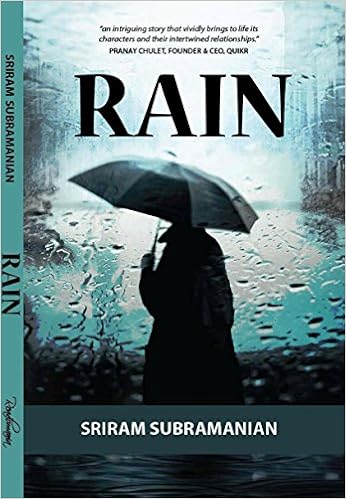
Review- Rain- Sriram Subramanian


Blurb: Architect Jai Dubey trusts in reason - not for him the faith and prayer so firmly ingrained in his fellow countrymen. When fortune deserts Jai and his carefully ordered life spins inexorably out of control, Jai stands on the brink of ruin. Only a delayed monsoon can save Jai’s biggest project from disaster, but there are millions across the land praying for the exact opposite. 
Reason seems to have its limits - the weather defies all prediction, let alone control. 
Will Jai relinquish the beliefs of a lifetime? Will he reconcile with the awful ambiguity about his past? Will he be able to save his crumbling marriage? 

Before I proceed to critique the book, let me provide some context. The day I started reading the book on my smartphone, we were moving from Goregaon to Kandivali. The entire day went buy in getting stuff packed and moved- you can imagine the chaos. And yet in the middle of this chaos, I finished to read the entire book in a day! All 200 pages of it were done by the time I went to sleep. I was helping my mother with the movers, and then reading in breaks. The book was so interesting I couldn't put it down. 

This is the story of Jai Dubey and his 'different' ideals- how he has his own construction company, a small entity working for small time businesses and staying afloat. Jai is very particular about sticking to his guns- he won't work for many clients at a time so he can give each project his best instead of taking on numerous projects and doing most half-baked. He knows he could make more money with more clients but quality matters more to him. He loves his wife who has a job of her own, and supports her career. He puts up with his shrill, nasty mother-in-law and brother-in-law Ashok who's a wily politician, jams with his scientist father-in-law and takes care of his employees and friend-cum-business partner. He's an atheist who doesn't fall for the religious mumbo jumbo of his Marathi in-laws. 
I found Jai quite relatable because I found a little of myself in him- independent, rational and solid personal principles.


All this falls flat when his mother in law challenges him to build a proper home for her daughter and not make her live in a rented apartment. Jai goes on to make some major choices...unusual ones that cost him  a lot- his friend and business partner Ravi, his business, and most of all threatens to tear apart his marriage. At the same time he's dealing with demons from his horrible past, most of which he has blocked out and is trying to recover. Then he makes some really drastic decisions and they change the way he looks at life itself. 

The characters are all well fleshed out, but the best is Jai's. His ideals and how they come in conflict with his situation, how he changes his way of thinking overtime, how he fails to make the right choices at the right time...Jai is endearing in his fallibility, his self-doubt, his making poor choices. 

There was also a constant thread of suspense in the book, all created by Jai's actions. What will he do next, and where will his choices take the plot? 

Sriram writes extremely well- the prose is of high quality and he doesn't let up once in language and grammar. The editing is excellent and his skill as a wordsmith shows in the fact that he has managed to write evocatively without using one big word throughout. That's true craftsmanship. That stuff takes practice- reading a lot, writing a lot and then getting your writing critiqued by neutral parties who will give an unbiased review. 

I was a little eager to get through the philosophical parts, and some of Jai's actions are really weird. Enumerating those would mean providing spoilers so I won't talk about them. But needless to say the bumps are few and don't affect on the overall appeal of the story.

Sriram has obviously been through the proper whetting process and come out shining. In a scenario where people who have never picked up a novel in their life before are venturing to write books and become bestselling authors, and where authors deliberately dumb down language, grammar and content to appeal to the mass market, Sriram is a noteworthy exception. In refusing to compromise on quality, he has shown his mettle, his integrity as an author who respects his craft and whose work will endure the ravages of time. 

RAIN is a touching story of a man confused in his ideals, fighting his personal demons, and coming out victorious. This book checks all the criteria for quality literature. Go buy your book and encourage authors like Sriram: RAIN


Monday, 12 September 2016

Society and sensational women: A Passing Glance

So last week I read about two sensational women, namely, Rekha and  the late Madhavi Kutty. Rekha is a Bollywood actress whom, despite her experience in the film industry you can't dismiss as yester-year because she's still acting or dancing to item numbers. Madhavi Kutty, also known as Kamala Das, is a poet and novelist- I say 'is' because even though her physical form has passed away, her spirit lives on through the mark she left on literature in India.
There was an article in Outlook ( Through the Author's Veil) that talks about a new book coming out on her personal life, which was rife with controversies. I read some of Kutty's poetry while in school, but came to know of her life only now.
Rekha is a Bollywood celebrity, and that sort of predisposes her to a colorful life ( although there are people who keep a low profile and don't court controversies). Whether it's her doomed love life, the bordering-on-sexual-harassment incident with actor Biswajeet when she was barely fifteen on a movie set, her origins as the love child of famous South Indian artistes, her makeover, the sexist comments made on her looks by actors and directors, her rumored affair with Big B, the suicide of her husband Mukesh Agarwal for which she was demonized...Rekha has lived a life filled with ups and downs. All this is chronicled in a book on her recently released by Juggernaut (Rekha- The Untold Story).
What is similar about the two women mentioned above? They are, by profession, as disparate as possible. And yet I perceive similarities in their personalities and lives. Namely:
1. Both are successful women in their fields
2. Both, whether willingly or not, courted controversies throughout their lives.
3. Both lived life on their own terms
4. Both never needed or used men to validate their existence. Their identities and reputations are based on their own individuality.
5. Both were reviled and criticized and demonized by a society still deeply entrenched in patriarchy because they refused to adhere to archaic diktats that control and oppress women.
6. Both used the public's sexist mentality and perverse hunger for sensationalism to their advantage. Both deliberately fanned rumors about their personal lives, especially love affairs, that created controversies and put them in the limelight. And both benefited from it as well!

It's the last point that makes these two most remarkable. It's an ugly truth that a patriarchal society like India will never let maverick women like Madhavi and Rekha just be. They will vilify, adore and probe and intrude and generalize as it suits their regressive, hypocritical mentality. An extension of this mentality is exhibited by a sleazy, unethical media which will go to any lengths to pull famous people, when they can, to sell copies to a perverse reader base that craves controversy and titillation. Famous women especially are soft targets- because they're women and the media is no less sexist than the general public.

Friday, 15 July 2016

Review- Two 'Unfinishable' Books


As much as I tried, I could not ring myself to finish the both of these books. Maybe my reading preferences, preconceived notions about both literature and society, and my penchant for well written books with stories that make sense is responsible.

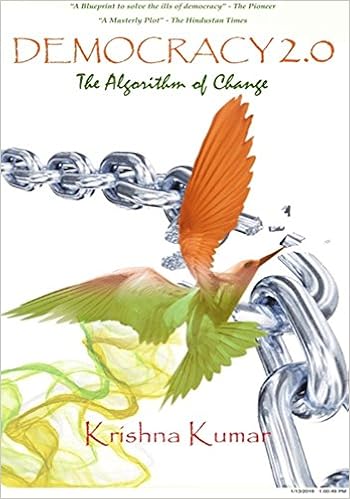
My different educational and social background from the author maybe the reason I couldn't read Democracy 2.0. There's no real story, no characterization, no plot, no agency, no goals, no direction to the tale. The novel's blurb suggests it is about a revolution but it peddles and perpetuates all cliches in the Indian educational system. It repeats the same old rhetoric about MBBS/Engineering and then IAS- the path most students take when they don't go down the B.Tech-MBA way. The book blatantly ignores other unexplored fields like pharmacy, journalism, literature etc. as a revolution for young people for career choices- that's how India's actually going to rehaul it's socio-educational structure and the nation can think of developing. There are also cliches regarding women and how they should live and behave. The book perpetuates a patriarchal domination of public spaces and discourses in the Indian milieu. Some revolution.
Like I said, my different educational and social background from the author maybe why the book didn't click with me. The author should seriously read some actual books and learn how to write a story. This sounds like a fancy version of a boring government report.

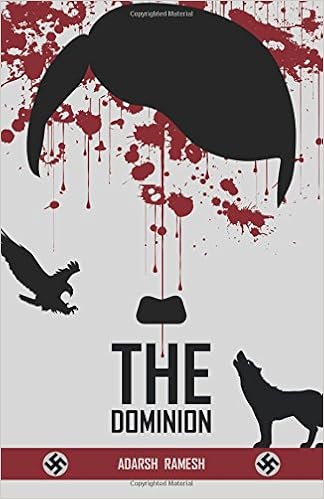
The Dominion sounds like an interesting novel on the outside. But once you start reading you find out how flawed this book is. There is no cohesion to the narrative. I cannot make head or tail of the story no matter how hard I try. The flawed language and grammar, and numerous typo errors, make the novel more difficult to comprehend because it's obfuscating the story. This made it all the more difficult to proceed with the book. The author said they took three years to write the book- but this is a very poor output. No cohesion of narration, no discernible plot structure, no pacing, no semblance of sanity in the story...made the book difficult to click with me. I can only proceed with a novel when it 'clicks' with me, interests and intrigues and invites me, in the first few pages. This book, alas, fails to do that. The author needs to go back to the drawing board and rehash their skills and their understanding of the basics of the craft.

Thank you.

Saturday, 2 July 2016

Review-Among the Stars- Dhasa Sathyan


Usually my reviews are long and detailed; but for this book I'll keep it relatively short and sweet. The author sent me a free copy in exchange for an honest review, so I owe him an honest review. This book is one of those you can delineate easily into the strong points and flaws, so I'll directly talk about that and try to be as lucid as possible.

First, the good points of the book:
1. The themes: In a scenario where the reader base in India is dangerously, and depressingly, tilted towards soppy, cold turkey romance novels, the author has made the right choice by opting to write a book of short stories about various human themes brought together under the umbrella of twisted, dark storylines ( another reason it clicked with me). From zombie horror to psychotic army men to psychedelic plants on mysterious deserted islands, the author has got the variety right and interesting.
2. Ideas have potential: The ideas are original and have potential, if explored properly, of making for mind-blowing stories.
3. Emotional intelligence: The stories speak of everyday human beings, our varying moods, shades and fantasies. Emotional intelligence in a book is important, at least for me, as a reader, to connect with it.

Flaws: As good is the idea of the book and its potential to shine, Among The Stars fails miserably in execution. And that's the sad part- to see books with great potential never realize their own capacity for greatness. Where it fails:
1. Language: Honestly, from the quality of writing, it's glaringly obvious that the author has had lack of practice- both in reading and writing. Too many big words and too much purple prose. A mistake many first-time writers make, seeking to impress by usage of complex words and phraseology. Wrong. The reader seeks the story, the context, something they can relate to first; and vocab second. You don't need complicated language to tell a great story and leave an impact- your writing becomes powerful when you string simple, lucid language together in an effective manner.
This needs practice. You need to read and read and read books till your mind resonates with words that coalesce into ideas. You need to write and get your work critiqued, then write more and more critique till you can pack those ideas cogently into power-packed prose. This is inevitable.
2. Grammar and quality of prose: Grammatical errors-basic ones- dot the landscape of the book, and take away from the stories. Add in the poor use of language and the prose becomes stilted and difficult to sift through. As a reader I'm being blocked because the author hasn't packed any flow into the prose. There's no finesse, and the prose is languid, lacklustre.
3. Poor editing: The editor can still take away some of the inadequacy by at least window dressing the work- especially in this case where the author lacks basic language skills and grammar skills. But where the editor disappear into on this one?
Will make a comment here, even though it's perhaps not my place to make it. Has the editing been ignored because the publisher is a vanity publishing house? Then I would advise the author to go with a traditional publisher next time, or hire a good editor if the publisher is a small or middle-level press. Editing IS important, no matter how much we are awestruck with Chetan Bhagat's bestselling status despite the horrible language and grammar and lack of editing.
It may take time, and numerous attempts, to find a good trad pub house- but in the mean time the author can hone his writing skills by reading a lot, writing a lot and getting his work critiqued by other writers in critique groups.

But do check the book out because it has some really original ideas in store: Among The Stars